
 | What is Happening to M. Salah? From Penalty King to Bench Dilemma |
World News • Emmanuel Onyemaechi • 11 April, 2026
» Updated 1 hour ago
Artemis II Crew Completes Historic Lunar Flyby, Safely Returns to Earth
66 Views
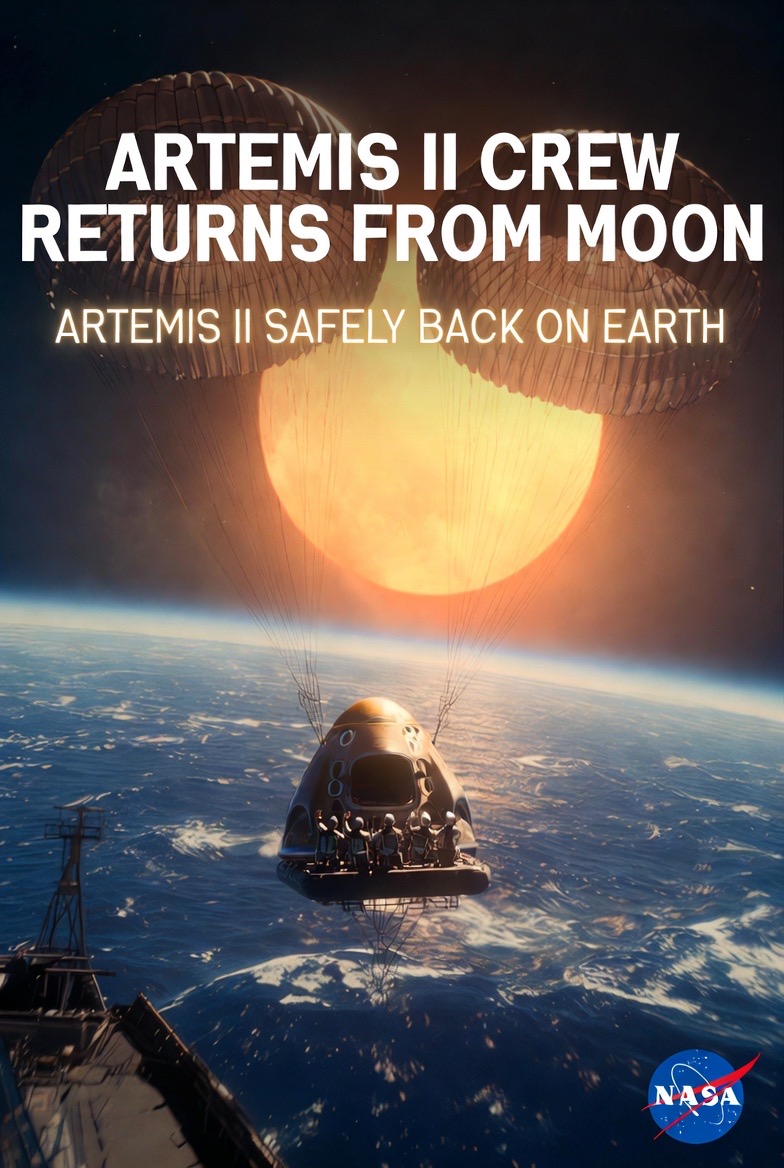
Four astronauts returned safely to Earth late Thursday after NASA’s Artemis II mission, the first crewed voyage to the Moon in more than half a century. The Orion spacecraft, nicknamed “Integrity,” splashed down in the Pacific Ocean off San Diego, California, at 8:07 p.m. PDT on April 10, 2026, capping a 10-day journey that tested critical systems for future lunar landings.
Commander Reid Wiseman, Pilot Victor Glover, Mission Specialist Christina Koch of NASA, and Mission Specialist Jeremy Hansen of the Canadian Space Agency were all reported in good health as recovery teams from the USS John P. Murtha pulled them aboard. The crew spent their first night back on Earth undergoing routine medical evaluations before heading to NASA’s Johnson Space Center in Houston for further debriefings.
The mission launched flawlessly from Kennedy Space Center on April 1 aboard the powerful Space Launch System rocket. After reaching lunar orbit, Orion performed a precise flyby of the Moon on April 6, skimming just 60 miles above the lunar surface and swinging around the far side — a region never visited by humans since the Apollo era. During the closest approach, the crew captured stunning images of the Moon’s rugged terrain and conducted a series of system checks on Orion’s heat shield, life-support systems, and navigation technology.
The flyby also set a new record: at their farthest point, the astronauts were farther from Earth than any humans since Apollo 13 in 1970. “We went farther than any humans have gone in 56 years,” Wiseman said in a live transmission during the lunar swing-by. “This is just the beginning of our return to the Moon — and beyond.”
Artemis II was designed as a full end-to-end test of Orion in deep space before the planned crewed landing of Artemis III, currently targeted for 2027 or 2028. No landing was attempted on this flight; instead, the crew focused on verifying the spacecraft’s performance under the harsh conditions of cislunar space.
NASA Administrator Bill Nelson hailed the mission as a triumph of international cooperation and engineering. “Today, four brave explorers proved that humanity’s future in space is bright,” he said. “Artemis is not just about going back to the Moon — it’s about building a sustainable presence there that will open the door to Mars and the rest of the solar system.”
The successful return marks the first time humans have traveled to the vicinity of the Moon since Apollo 17 in December 1972. No other crewed lunar missions are currently underway. China has announced ambitions for a crewed lunar landing by 2030, while several private companies continue to develop uncrewed landers and support systems.
Recovery operations proceeded smoothly, with the capsule floating upright in calm seas as divers and engineers secured it. The astronauts are expected to begin a period of quarantine and scientific debriefing as teams analyze the wealth of data collected during the flight.
For millions watching live, the splashdown was more than just a safe return — it was a powerful reminder that the era of lunar exploration has resumed. As Hansen put it shortly after splashdown: “We came, we saw, we flew around the Moon — and now we’re home. Can’t wait to do it again… but next time, we’ll stay a little longer.”
The full mission data and imagery are being processed and will be released in the coming weeks.

Recently Viewed Posts

|
What is the Meaning of FECA FOSM? 126 views |

Most Read Posts




Latest Updates

FECA Nigeria Okigwe Chapter Unveils All Secondary School Summit 2026
- April 17, 2026

FECA Nigeria Rivers Zone Announces High Calling Conference 2026!
- April 17, 2026
Tony Elumelu Pens Heartfelt Tribute to Aliko Dangote
- April 16, 2026
Tony Elumelu Pens Heartfelt Tribute to Aliko Dangote
- April 16, 2026
Lookman Strikes Atleti into Semi-Final in Champions League
- April 15, 2026Recent Events and Flyers

3 hours ago

4 days ago

3 hours ago

8 hours ago

Video