
 | What is Happening to M. Salah? From Penalty King to Bench Dilemma |
Conventions • Emmanuel Onyemaechi • 16 February, 2026
» Updated -1414 seconds ago
FECA Nigeria National Conventions: The Early Years (2000-2026)
377 Views
In the year 2000, FECA National convention held in Port Harcourt, marking a significant gathering for the Federation of Colleges Ex-Students' Christian Association during its formative growth phase. In the next two years, in 2002, FECA National convention happened in Abuja, bringing together believers from across Nigeria's regions to Abuja's central location that facilitated national unity and coordination. By 2004, FECA National convention happened in Warri, Delta State, demonstrating the organization's expanding footprint into the Niger Delta region and showcasing FECA's commitment to rotating conventions across Nigeria's geopolitical zones. This was made public by Rev. Christian Ahmed during the 2022 national convention.
These early 2000s conventions represented critical milestones in FECA Nigeria's development trajectory after formal registration with the Corporate Affairs Commission in 2008. The Port Harcourt 2000 convention occurred when FECA operated primarily through chapter networks without centralized corporate status, relying on the passion of student leaders and ex-students committed to the vision of redeeming Nigeria's desolation. Abuja 2002 positioned FECA centrally during national political transitions, while Warri 2004 strengthened Western region engagement alongside Eastern and Northern chapters already established through biennial gatherings.
Each convention served multiple purposes beyond spiritual edification. Freshers gained comprehensive orientation about FECA's mandate while senior members networked across chapters, fostering the federal structure that defines FECA operations today. These gatherings established patterns for subsequent national conventions held annually or biennially depending on leadership cycles and regional hosting rotations. The strategic location choices reflected FECA's deliberate inclusivity ensuring no single region dominated spiritual leadership while exposing participants to Nigeria's diversity.
The early conventions laid groundwork for FECA's current structure featuring four regional conventions alongside national gatherings. Port Harcourt 2000 particularly stands out as many leaders trace transformative kingdom encounters to that watershed moment when FECA transitioned from informal fellowships to structured national movement. Abuja's centrality facilitated coordination between emerging Northern chapters and established Southern hubs while Warri 2004 solidified Delta region's role within Western operations.
These foundational conventions established traditions that continue shaping FECA Nigeria's identity three decades after inception. The rotation pattern prevented regional dominance while exposing participants to diverse worship expressions, leadership models, and kingdom strategies adapted to local contexts. Successive generations of FECAites reference these early gatherings when explaining organizational resilience through consistent convention culture that survives leadership transitions, economic challenges, and national upheavals.
The 2000-2004 convention cycle particularly captures FECA at youth ministry crossroads transitioning from student-led fellowships toward structured Christian association serving Nigeria's redemptive mandate across generations. These gatherings produced leaders who scaled chapters into enduring institutions while maintaining spiritual hunger characteristic of original vision carriers who first converged in Calabar decades earlier.
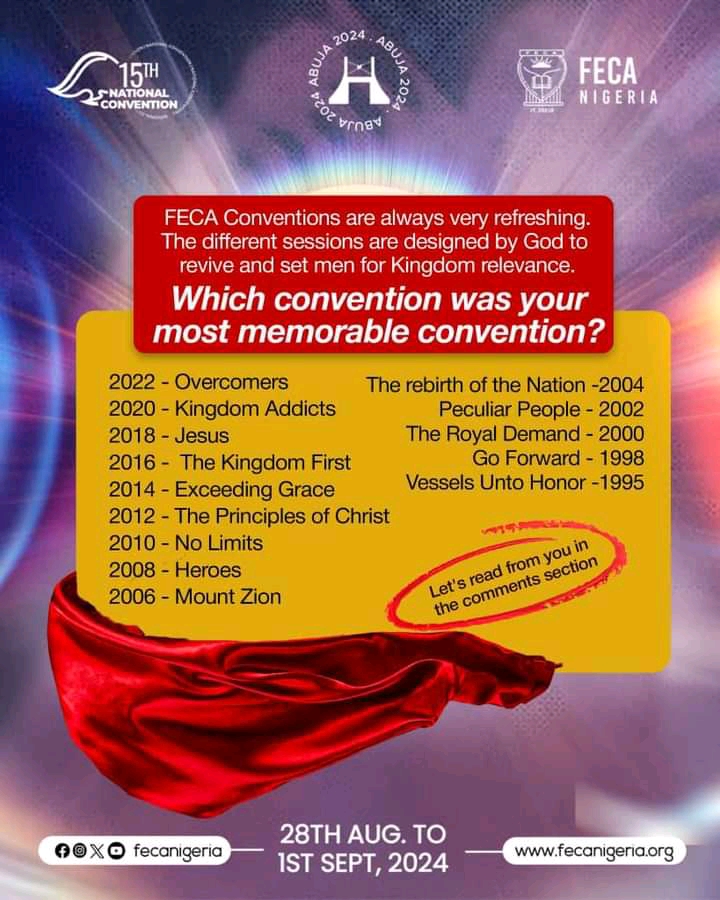
Flyer Insights: 25+ Years of Themed Momentum (1998-2024 Highlights)
The 15th Convention flyer masterfully lists transformative themes, unveiling FECA's historiology arc from foundational honor to dominion – a visual timeline of revivals shaping ex-students into Kingdom giants:
- 2022: Overcomers – Post-COVID resilience, fortifying faith amid lockdowns and virtual pivots.
- 2020: Kingdom Addicts – Lockdown-fueled virtual fellowships, addicting youth to Jesus-forward living.
- 2018: Jesus Forward – Evangelism surge, propelling outreaches like freshers banquets nationwide.
- 2016: Exceeding Principles – NLT/NLR integrations, exceeding grace for principled exploits.
- 2014: The King's Grace – Grace revivals, echoing Enugu's "King's Grace" mentorship waves.
- 2012: No Limits in Christ – Expansion era, birthing chapters like Odenigbo (2011 roots).
- 2010: Heroes – Mentorship focus, honoring vessels like Azam and Romzy precursors.
- 2008: Mount Zion Men – Apostolic shift, mounting Zion-level mandates for men/women.
- 2006: [Regional Emphasis] – Gap bridged by surging regional pushes (e.g., Eastern "history" builds).
- 2004: The Rebirth of the Nation – Prophetic rebirth in Abuja, rebirthing Nigeria's spiritual landscape.
- 2002: Peculiar People / Royal Demand – Identity forged in Enugu/Port Harcourt, demanding royal priesthood.
- 2000: Peculiar People – Port Harcourt peculiarity roots, setting national identity.
- 1998: Vessels Go Forward Unto Honor – Benin foundations, vessels advancing to honor amid Abacha transitions.
This progression – from "Vessels" (sanctification) to "Dominion Mandate" (2024 authority) – mirrors FECA's maturity: 1990s planting → 2000s identity → 2010s expansion → 2020s dominion. Flyer's call to comment your fave? Mine: 2004 Rebirth – Abuja vibes presaged 2024's shift.
Patterns: Themes cycle revival (rebirth), identity (peculiar/royal), dominion (2024), mirroring FECA's growth from 10 girls to 29 states, 2024-2026 leaders like Kenneth Louis.
Broader Historiology: FECA Conventions' Evolution, Enduring Challenges, Profound Impacts, and Forward Momentum
Tracing FECA Nigeria National Conventions' broader historiology reveals a remarkable evolution from grassroots logistical hurdles – no websites, relying on word-of-mouth buzz and iconic T-shirts for publicity – to structured powerhouses birthing enduring frameworks like biennial NEC elections (e.g., 2024 Abuja ushering Kenneth Louis's team), signature FECA Prays as anti-desolation spiritual warfare, and variety nights blending cultural evangelism with drama/songs to draw street converts. Yet challenges persist: venue relocations (2024's Jos-to-Abuja pivot mirroring 2023 Eastern reschedules due to IPOB tensions), bootstrapped funding where T-shirt sales remain a lifeline, testing resilience amid Nigeria's socio-political turbulence. The profound impacts shine brightest, raising Kingdom giants like Enugu zone's fiery Azam (2012-2014), Nsukka's steadfast Onyemaechi (2020-2022), and Jos 1's wise Samuel Isaac (2022-2024), whose tenures amplified chapters nationwide. This legacy propels ahead to 2026's NLR "ADVANCE," building unstoppably on convention revivals.
As the 15th Convention flyer queries: Which one revived you most? Share in comments below! Abuja 2024's "Dominion Mandate" (August 28–September 1) seamlessly continues this redemptive thread – register now at fecanigeria.org to join the generations-redeeming movement FECA ignited in 1990. Jesus is Lord!
Recently Viewed Posts


Most Read Posts



Latest Updates


5 QUESTIONS THAT HELPS YOU PREPARE FOR YOUR SOULMATE
- April 26, 2026
5 QUESTIONS THAT HELPS YOU PREPARE FOR YOUR SOULMATE
- April 26, 2026
32 POWERFUL USES OF ONION
- April 26, 2026
Recent Events and Flyers
2 days ago
2 weeks ago
1 week ago
1 week ago

Video